Syahilla Script Font: A Sweet, Friendly Handwritten for Modern Branding
Last week, I was sitting in front of a blank brand board for a small artisan bakery. The client wanted something warm, approachable, and just a little bit cool—the kind of visual personality that makes you feel like you’re walking into a cozy corner shop run by someone who actually bakes sourdough with love. I had already sketched a few logo concepts, but nothing clicked until I dropped Syahilla Script onto the canvas. That first test immediately changed the direction of the entire project. The letterforms had a natural bounce that felt spontaneous without being messy, and there was a subtle elegance hiding behind the playful curves. I knew right then this font deserved a closer look in real branding work.
First Impressions: The Personality of Syahilla Script
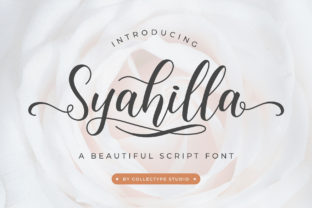
Out of the box, Syahilla Script lands somewhere between a friendly handwritten note and a polished modern script. The strokes are smooth, with a gentle slant that gives it motion without making it feel rushed. The uppercase letters carry a bit of extra flair—notice the loop on the capital ‘S’ or the tail on the ‘R’—but they never tip into overly ornate territory. What struck me most was the balance between sweetness and structure. This is a font that feels personal, like something you’d write with a favorite gel pen, yet it maintains consistent weight and rhythm across all characters.
The lowercase set is where the real charm lives. Letters like ‘a,’ ‘g,’ and ‘y’ have open, friendly counters that improve readability even at medium sizes. The alternate characters and ligatures I discovered later gave me even more control when crafting wordmarks. For a script handwritten typeface, Syahilla Script manages to avoid the common pitfalls of being too rigid or too wild. It’s versatile enough to anchor a brand identity but carries enough personality to hold its own as a decorative accent.
Testing Syahilla Script in Real Branding Work
I put Syahilla Script through a series of realistic design scenarios to see how it held up beyond the initial excitement. The first test was always going to be a logo draft for that bakery. I set it as a standalone wordmark, then tried it with a simple icon mark. The font handled the primary logo role nicely—the word “bakery” in Syahilla Script looked inviting on a kraft paper mockup, and the ligatures helped the letters flow together into a single visual unit. I also compared it with a few other script fonts in my library. Some were too formal, others too casual. Syahilla Script sat right in that sweet spot between friendly and professional.
Next came packaging. On a small paper bag and a product label, the font maintained its character at around 18 to 24 point sizes. The thin strokes didn’t get lost in the print, and the overall feel matched the artisanal vibe the client wanted. I then moved to social media graphics: an Instagram post with a quote about “made with love” set in the font looked natural against a soft pastel background. The handwritten quality made the content feel less like corporate marketing and more like a genuine conversation. For a website hero section, I paired Syahilla Script with a clean sans serif for body text, and the contrast worked beautifully. The script drew the eye to the headline without overwhelming the rest of the layout.
I even tested it on a business card and a small poster. At small sizes—around 10 or 11 points—some of the finer details started to blur, especially on uncoated paper. That’s a common limitation for many script handwritten fonts, and Syahilla Script is no exception. But as a display or accent typeface used above 14 points, it performed admirably across print and digital touchpoints. The font also includes a solid set of numerals and punctuation, which is a relief when you need to incorporate a phone number or address into a layout without switching typefaces awkwardly.
Where Syahilla Script Shines (and Where It Doesn’t)
Syahilla Script is best used as a display font for headlines, logos, short phrases, and decorative elements. Its natural rhythm makes it an excellent choice for boutique brands, creative studios, handmade product labels, café signage, and editorial headers. If you’re working on a project that needs a warm, modern handwritten feel—something that feels handcrafted but not amateur—this font is a strong contender. The alternate characters and ligatures add enough flexibility to customize the look for different applications without starting from scratch every time.
However, let’s be realistic about where this typeface won’t do you any favors. Long body text is not its strength. At small sizes or in dense paragraphs, the script style becomes difficult to read, especially for extended reading. Avoid using Syahilla Script for lengthy descriptions, legal copy, or any text that needs to scan quickly from a distance. Formal corporate reports, medical communications, or anything requiring strict neutrality will be better served by a clean serif or sans serif font. The playful nature of Syahilla Script also means it may not suit serious or luxury brands that demand a more subdued elegance. Use it where personality matters, not where authority or minimalism is the goal.
Before committing to a final design, I always recommend testing the font at various sizes in both print and screen. Load it into a mockup, print a label sample, and view it on a mobile device. Pay attention to how the thin strokes appear in different media. The font’s modern look is striking, but like any tool, it works best when you understand its limitations. Syahilla Script is a creative font that rewards thoughtful placement.
Font Pairing with Syahilla Script
Because Syahilla Script already brings a lot of character, the best companions are simple, grounded typefaces that let the handwritten style take center stage. During my brand identity test, I paired it with a classic serif font for the body copy. The contrast between the structured serifs and the fluid script created a clear visual hierarchy. A neutral sans serif—something with geometric or humanist proportions—also works well for subheadings, captions, or navigation menus. I tried a lightweight sans serif on a website mockup, and the combination felt modern without being cold.
If you’re building a larger typography system, you might also consider a second handwritten font for accents or secondary messages, but keep that pairing subtle to avoid visual noise. The key is to let Syahilla Script lead the emotional tone while a simpler partner handles the functional reading tasks. For editorial projects, a clean serif for pull quotes and a sans serif for body text alongside Syahilla Script for titles gives a professional, layered result.
Important Notes on Licensing and Formats
Before you start using Syahilla Script in client projects, take a moment to review the commercial font license that comes with your purchase. Many premium fonts restrict usage in certain situations—such as embedding in digital products, using in logo trademarks, or applying to print-on-demand merchandise. The good news is that Syahilla Script is typically offered with standard web and desktop licenses, but always confirm what’s covered. I make it a habit to keep a copy of the license agreement in each project folder, especially when packaging design assets for clients who may want to reuse the font across multiple platforms.
The font file formats usually include OTF, TTF, and WOFF or WOFF2 for web use. Check that the version you download includes all alternates, ligatures, and multilingual support if you need special characters for different languages. Syahilla Script’s modern look translates well across most browsers and design software, but running a quick test on your actual project files saves time later. If you plan to use it on a website, verify that the webfont loads properly on mobile devices and that the script retains its shape at different screen sizes.
After a full week of testing Syahilla Script across a branding project, I can honestly say it earned a spot in my regular font library. It delivers on the promise of a sweet, friendly handwritten font with a cool modern edge. Whether you’re a designer working on a boutique identity, a small business owner crafting your own packaging, or a creative studio looking for a fresh display typeface, this script font offers a reliable, character-rich option that doesn’t require you to sacrifice professionalism for personality. Just remember to pair it thoughtfully, respect its size limits, and license it properly—then let it bring warmth to your next project.